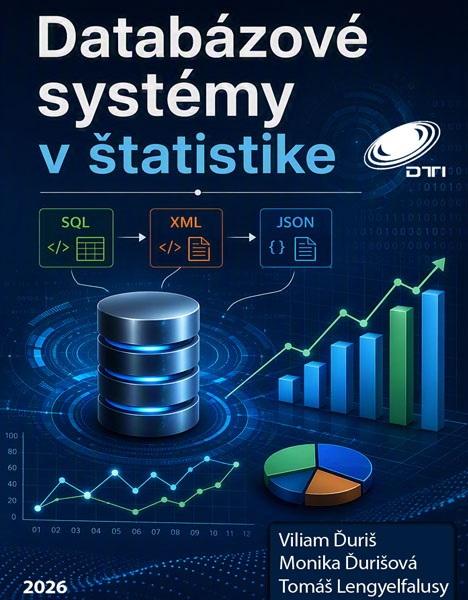
The textbook *Database Systems in Statistics* is intended for students of professionally oriented and natural science faculties, in both full-time and part-time study programmes, primarily for the course *Database Systems in Statistics*. It may also be useful to students of other disciplines focusing on database systems, data processing, statistics, and database application programming.
In terms of its content and structure, the textbook represents a distinctive publication. Its treatment of database-related topics is not limited solely to relational databases and the SQL language, but also covers the XML, CSV, and JSON formats, which are now commonly used for storing, transferring, and exchanging data between different information systems. Particular attention is paid to processing these formats in the RAD Studio – Delphi environment. There are relatively few textbooks that combine relational databases, SQL, data exchange formats, and the development of database applications in Delphi within a single comprehensive publication. Moreover, the textbook addresses individual topics in considerable depth and also covers issues related to the consistency, integrity, and security of database systems.
A specific feature of the textbook is its focus on statistical databases. The principles, data structures, examples, and exercises presented are therefore explained primarily in relation to data encountered in statistical processing. Attention is paid not only to data storage and retrieval, but also to proper data representation, validation, integration, filtering, aggregation, and preparation for further analysis. The publication includes practical examples, source code, and exercises that enable students to master the topics covered by working with specific database and statistical problems. A basic knowledge of the RAD Studio environment, the Object Pascal programming language, and elementary principles of working with data is assumed.